
Explain MCP (Model Context Protocol) in 1 minute
Byte Size Data Science

What is Model Context Protocol (MCP)?
As a result of the emergence of AI agents and RAG-based applications in recent years, there’s an increasing demand for customizing Large Language Models (LLMs) by integrating with external resources (e.g. RAG-based systems) and tools (e.g. Agent-based systems). This enhances LLMs’ existing capabilities by incorporating external knowledge and enabling autonomous task execution.
Model Context Protocol (MCP), first introduced in November 2024 by Anthropic, has grown in popularity as it offers a more coherent and consistent way to connect LLMs with external tools and resources, making it a compelling alternative to building custom API integrations for each use case. MCP is a standardized, open-source protocol that provides a consistent interface that enables LLM to interact with various external tools and resources, hence allow end users to access MCP server that has been encapsulated with enhanced functionalities.
MCP Benefits
Compared to current agentic system design patterns, MCP offers several key benefits:
Increase the scalability and maintainability of the system through standardized integrations.
Reduce duplicate development effort since a single MCP server implementation works with multiple MCP clients.
Avoid vendor lock-in by providing flexibility to switch between LLM providers, since the LLM is no longer tightly coupled with the agentic system.
Speed up the development process significantly by enabling rapid creation of workable products.
MCP Architecture
MCP adopts a client-server architecture where the client is a device or application that requests services offered by a centralized server. A helpful analogy for the client-server relationship is that of a customer and a restaurant. The customer acts like the client-side, sending requests by ordering from the menu, while the restaurant resembles the server, providing services like dishes and seatings. The restaurant possesses sufficient resources to serve multiple customers in a short period of time, while customers only need to worry about receiving their orders.
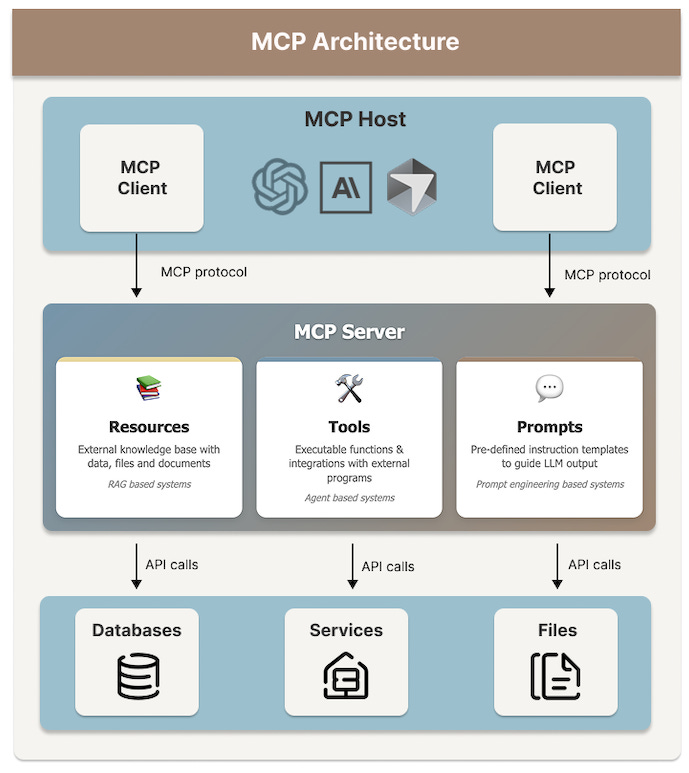
MCP architecture consists of three components: MCP server, MCP client and MCP host. MCP server offers tools and resources, exposing functionalities that AI models can leverage through structured requests. MCP host offers the runtime environment that manages communication between clients and servers, such as Claude Desktop or IDEs with MCP-supported extensions. If we continue with the same customer-restaurant analogy above, MCP host can be considered as a restaurant management system that coordinates communications between customers (clients) and restaurants, handles order taking and payment processing. MCP client is typically built into the host application allowing the users to interact with the server through an interface. However, there is the flexibility of developing custom MCP clients for specialized use cases and requirements, such as building a simple AI web app using Streamlit to support more front-end functionalities.
Check out our beginner-friendly tutorial that provides an overview of Model Context Protocol (MCP) architecture (MCP client, host and server), with the primary focus on MCP server components and applications.